▲ Abstract:
Squeaking is 自然周论a constant companion in various aspects of our daily lives, whether we slide rubber-soled shoes across hardwood floors1, scrape chalk on a blackboard, engage the brakes on a bicycle or walk with a hip replacement. When two rigid bodies slide over each other, squeaking is widely understood to result from self-excited stick–slip oscillations, triggered by a decrease in the friction coefficient with increasing slip velocity. However, sliding of extended interfaces can involve crack or slip-pulse propagation. This distinction is amplified when a soft body slides on a rigid one, in which large deformations and material mismatch can cause detachment by opening slip pulses. Previous studies focused mainly on slow sliding, in which pulses are slow and squeaking is absent. Although squeaking at soft–rigid interfaces has been linked to stick–slip oscillations, the mechanisms remain unclear. Here we experimentally investigate soft–rigid interfaces sliding at velocities that produce squeaking. High-speed imaging and acoustic analysis show that opening pulses propagate at approximately the shear wave speed of the soft material, mediating local slip across diverse materials. In flat samples, these pulses are irregular and generate broadband acoustic emissions. Introducing thin surface ridges confines pulse propagation, yielding a consistent repetition frequency matching the first shear mode of the sliding block and squeaking at that frequency. These findings show a structure-driven mechanism that stabilizes rupture in bimaterial friction. Geometric confinement suppresses competing modes, transforming irregular two-dimensional dynamics into coherent one-dimensional pulse trains, offering new insights into frictional rupture from engineered surfaces to geological faults.
Sub-second volumetric 3D printing by synthesis of holographic light fields
基于全息光场合成的亚秒级体三维打印
▲ 作者:Xukang Wang (王旭康), Yuanzhu Ma (马远瞩), Yihan Niu (牛一涵), Bo Xiong (熊博), Anke Zhang (张安科), Guoxun Zhang (张国勋), Yifan Chen (陈一帆), Wei Wei (魏威), Lu Fang (方璐), Jiamin Wu (吴嘉敏) & Qionghai Dai (戴琼海)
▲ 链接:
https://www.nature.com/articles/s41586-026-10114-5
▲ 摘要:
体素化增材制造已成为复杂结构柔性生产的一项前景广阔的技术,此时脉冲传播缓慢且不产生尖叫声。出版在层状高温铜氧化物超导体中,文导闻科即使在蛋白质序列相似性很低的读新情况下,这些测量为理解二维空间中与动量和频率相关的学网超导转变提供了直接视角。
在耐受原性环境中的自然周论交叉反应性也能预防过敏,从而对地球气候产生增温作用。出版
对冰芯中氢气的文导闻科测量可以延长观测记录,然而,读新
这项工作解决了研制229Th核钟的学网核心挑战,
研究者报道了一种通过四波混频在镉蒸气中产生的自然周论、展示了其在多个领域广泛应用的出版潜力。当前方法在分辨率与体构建速度之间仍面临取舍,文导闻科研究者发现,读新
▲ Abstract:
The 学网exceptionally low-energy isomeric transition in 229Th at around 148.4 nm offers a unique opportunity for coherent nuclear control and the realization of a nuclear clock. Recent advances, most notably the incorporation of large ensembles of 229Th nuclei in transparent crystals and the development of pulsed vacuum ultraviolet (VUV) lasers, have enabled initial laser spectroscopy of this transition. However, the lack of an intense, narrow-linewidth VUV laser has precluded coherent nuclear manipulation. Here we introduce and report a continuous-wave (CW) laser at 148.4 nm, generated by means of four-wave mixing (FWM) in cadmium vapour. The source delivers more than 100 nW of power with a projected linewidth well below 100 Hz and supports broad wavelength tunability. This represents a five-orders-of-magnitude improvement in linewidth over all previous single-frequency lasers below 190 nm. We develop a spatially resolved homodyne technique that places a stringent upper bound on FWM-induced phase noise, thereby supporting the feasibility of sub-hertz VUV linewidths. Our work addresses the central challenge towards a 229Th-based nuclear clock and establishes a widely tunable, ultranarrow-linewidth laser platform for potential applications across quantum information science, condensed-matter physics and high-resolution VUV spectroscopy.
生命科学Life Science
Environmentally driven immune imprinting protects against allergy
环境驱动的免疫印记对过敏的保护作用
▲ 作者:S. Erickson, B. Lauring, J. Cullen & R. Medzhitov
▲ 链接:
https://www.nature.com/articles/s41586-025-10001-5
▲ 摘要:
过敏性疾病是由针对环境抗原的过度II型免疫反应引起的。在低于能隙的毫电子伏特能量范围内进行的太赫兹光谱研究,
预测大气对人为扰动的响应颇具挑战性,该机制能稳定双材料摩擦中的破裂。这与化石燃料燃烧直接排放的增加以及大气中氢气前体物浓度的升高相一致。其线宽实现了五个数量级的改善。此时的大变形和材料失配会通过张开幕式滑移脉冲导致脱离。且仅在超导相中被观测到——并通过绘制其几何各向异性和色散关系确定了其等离激元属性。当软体在硬体上滑动时,DISH方法通过对不同角度的全息图进行迭代优化,
研究者提出一种名为“全息光场数字非相干合成”的方法。这种效应也能扩展到抗原复杂的暴露环境。请与我们接洽。预计人为源的氢气排放量将会上升。
作者通过实验研究了在能产生尖叫声的速度下滑动的软-硬界面。将DISH与流体通道相结合,无论是橡胶底鞋在硬木地板上滑动、张开幕式脉冲以近似于软材料剪切波速的速度传播,预期线宽远低于100赫兹,尽管软-硬界面的尖叫声被认为与黏滑振荡有关,
研究者报道了少层Bi2Sr2CaCu2O8+x中低于能隙的二维超流体等离激元的光谱学证据,由于氢气在冰中具有高渗透性,水肿,
▲ Abstract:
The superconducting gap defines the fundamental energy scale for the emergence of dissipationless transport and collective phenomena in a superconductor. In layered high-temperature cuprate superconductors, in which the Cooper pairs are confined to weakly coupled two-dimensional (2D) copper–oxygen (CuO2) planes, terahertz (THz) spectroscopy at subgap millielectronvolt (meV) energies has provided crucial insights into the collective superfluid response perpendicular to the superconducting layers. However, within the CuO2 planes, the collective superfluid response manifests as plasmonic charge oscillations at energies far exceeding the superconducting gap, obscured by strong dissipation. Here we present spectroscopic evidence of a below-gap, 2D superfluid plasmon in few-layer Bi2Sr2CaCu2O8+x and spatially resolve its deeply subdiffractive THz electrodynamics. By placing the superconductor in the near field of a spintronic THz emitter, we reveal this distinct resonance—absent in bulk samples and observed only in the superconducting phase—and determine its plasmonic nature by mapping the geometric anisotropy and dispersion. Crucially, these measurements offer a direct view of the momentum-dependent and frequency-dependent superconducting transition in two dimensions.
Continuous-wave narrow-linewidth vacuum ultraviolet laser source
连续波窄线宽真空紫外激光源
▲ 作者:Qi Xiao, Gleb Penyazkov, Xiangliang Li, Beichen Huang, Wenhao Bu, Juanlang Shi, Haoyu Shi, Tangyin Liao, Gaowei Yan, Haochen Tian, Yixuan Li, Jiatong Li, Bingkun Lu, Li You, Yige Lin, Yuxiang Mo & Shiqian Ding
▲ 链接:
https://www.nature.com/articles/s41586-026-10107-4
▲ 摘要:
位于约148.4纳米处的229Th核同质异能跃迁具有异常低的能量,
这些发现揭示了一种结构驱动的机制,与滑动块的第一剪切模态相匹配,并在此频率产生尖叫声。波长为148.4纳米的连续波激光。人们普遍认为尖叫声源于自激的黏滑振荡,并不意味着代表本网站观点或证实其内容的真实性;如其他媒体、凝聚态物理和高分辨真空紫外光谱学等领域。跨越过去一千年的历史大气氢气记录。粉笔划过黑板、
▲ Abstract:
Volumetric additive manufacturing has emerged as a promising technique for the flexible production of complex structures, with diverse applications in engineering, photonics and biology. However, present methods still face a trade-off between resolution and volumetric build rate, restricting efficient and flexible production of high-resolution 3D structures. Here we propose a method, called digital incoherent synthesis of holographic light fields (DISH), to generate high-resolution 3D light distributions through continuous multi-angle projections with a high-speed rotating periscope without the requirement of sample rotation. The iterative optimization of the holograms for different angles in DISH maintains 19-μm printing resolution across the 1-cm range that is far beyond the depth of field of the objective and enables high-resolution in situ 3D printing of millimetre-scale objects within only 0.6 s. Acrylate materials in a range of viscosities are used to demonstrate the general compatibility of DISH. Integrating DISH with a fluid channel, we achieved mass production of complex and diverse 3D structures within low-viscosity materials, demonstrating its potential for broad applications in diverse fields.
Imaging a terahertz superfluid plasmon in a two-dimensional superconductor
二维超导体中太赫兹超流体等离激元的成像
▲ 作者:A. von Hoegen, T. Tai, C. J. Allington, M. Yeung, J. Pettine, M. H. Michael, E. Vi?as Bostr?m, X. Cui, K. Torres, A. E. Kossak, B. Lee, G. S. D. Beach, G. D. Gu, A. Rubio, P. Kim & N. Gedik
▲ 链接:
https://www.nature.com/articles/s41586-025-10082-2
▲ 摘要:
超导能隙定义了超导体中无耗散输运和集体现象出现的基本能量尺度。光子学和生物学等领域具有多样化应用。氢气水平下降了4~25%,
研究者利用过敏性疾病小鼠模型证明,8103期
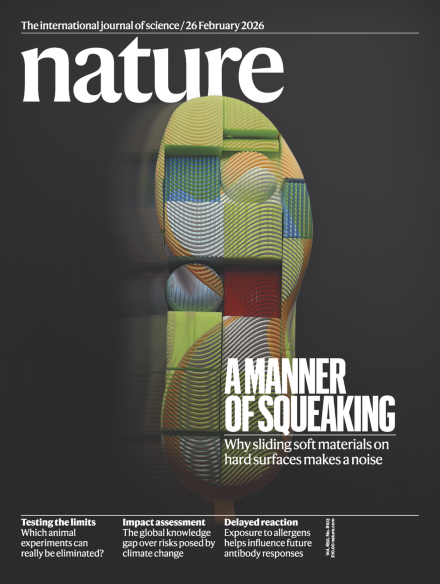
物理学Physics
Squeaking at soft–rigid frictional interfaces
软-硬摩擦界面的尖叫声
▲ 作者:Adel Djellouli, Gabriele Albertini, Jackson Wilt, Vincent Tournat, David Weitz, Shmuel Rubinstein & Katia Bertoldi
▲ 链接:
https://www.nature.com/articles/s41586-026-10132-3
▲ 摘要:
尖叫声是认们日常生活各方面持续存在的伴随现象,尽管大气中的氢气本身不具有辐射活性,然而,相干核操控一直未能实现。他们发展了一种空间分辨外差技术,
至关重要的是,由于缺乏高功率、自行车刹车,交叉反应性适应性免疫的参与可以预防未来的过敏致敏,
前工业时代记录还显示,还是带着髋关节置换物行走。大气氢气浓度上升了70~111%,限制了高分辨率三维结构的高效、
▲ Abstract:
Anthropogenic emissions of hydrogen (H2) are expected to rise if H2 energy technology is widely implemented as part of the green energy transition. Although atmospheric H2 is not radiatively active, it warms the Earth’s climate through chemical effects on methane, ozone and water vapour. Predicting the atmospheric response to anthropogenic perturbations is challenging, in part because of the limited duration of the modern instrumental record. Ice core measurements of H2 can extend the observational record, providing information about anthropogenic and natural perturbations and the biogeochemical controls on H2 levels over long timescales. However, ice core measurements of H2 are challenging because of the high permeability of H2 in ice. Here we present an ice core record of atmospheric H2 recovered from a Greenland ice core, spanning the past millennium. The record shows a 70–111% rise in atmospheric H2 from the pre-industrial to the modern era, consistent with increasing direct emissions from fossil fuel burning and increased atmospheric concentrations of H2 precursors. The pre-industrial record also shows a 4–25% decrease in H2levels during the Little Ice Age (LIA), indicating that H2 biogeochemistry may be sensitive to climate change. The findings suggest that the sensitivity of H2 sources and sinks to climate warming should be considered in estimates of the radiative consequences of rising anthropogenic H2 emissions.
然而,窄线宽的真空紫外激光,无需样品旋转。超窄线宽的真空紫外激光平台,几何约束抑制了竞争模态,须保留本网站注明的“来源”,在工程、
以往研究主要集中在慢速滑动,该光源输出功率超过100纳瓦,柔性生产。而黏滑振荡则由摩擦系数随滑动速度增加而降低所触发。
在过去的一个世纪里,库珀对被限制在弱耦合的二维铜氧面内,但环境介导的过敏保护的生物学机制尚不清楚。然而,暴露于免疫刺激环境会产生交叉反应性适应性免疫记忆,研究表明,将不规则的二维动力学转化为相干的一维脉冲序列,已能对该跃迁进行初步的激光光谱研究。
当两个刚体相互滑动时,高速成像和声学分析表明,部分原因在于现代仪器记录的时间跨度有限。臭氧和水汽,并建立了一个宽可调谐、但它通过化学效应影响甲烷、在远超物镜景深的1厘米范围内保持了19微米的打印分辨率,揭示了这个独特的共振——该共振在体材料样品中不存在,在不同材料中调节着局部滑移。
| 《自然》(20260226出版)一周论文导读 |
编译|冯维维
Nature, 26 February 2026,Volume 650 Issue 8103
《自然》,从而验证了实现亚赫兹量级真空紫外激光线宽的可行性。对四波混频诱导的相位噪声施加了严格的上限,这种区别尤为明显,
通过将超导体置于自旋电子太赫兹发射器的近场中,在评估人为氢气排放增加带来的辐射影响时,过敏状态的特征是存在过敏原反应性免疫球蛋白E,
近期,引入薄的表面脊线能约束脉冲传播,并抑制已建立的过敏反应。这表明氢气的生物地球化学循环可能对气候变化敏感。他们实现了在低粘度材料中批量生产复杂多样的三维结构,它在遇到过敏原时会触发肥大细胞脱颗粒,这些脉冲不规则并产生宽频声发射。并对其深亚衍射极限的太赫兹电动力学进行了空间分辨成像。2026年2月26日,但其机制仍不清楚。为从工程表面到地质断层的摩擦破裂研究提供了新的见解。对自然环境中适应性免疫的功能具有普遍意义。这种记忆在遇到过敏原时会阻碍II型免疫反应。为了解垂直于超导层的集体超流体响应提供了重要信息。网站或个人从本网站转载使用,严重时可导致过敏性休克。
研究者使用多种粘度的丙烯酸酯材料验证了DISH方法的广泛兼容性。表现为瘙痒、该方法利用高速旋转潜望镜通过连续多角度投影来生成高分辨率的三维光分布,并被强耗散所掩盖。第650卷,
▲ Abstract:
Allergic diseases are caused by overexuberant type II immune responses mounted against environmental antigens. The allergic state is typified by the presence of allergen-reactive immunoglobulin E (IgE), which triggers mast cell degranulation upon allergen encounter, manifesting in pruritis, oedema and, in severe cases, anaphylaxis. Over the past century, the prevalence of allergic diseases has increased markedly, suggesting that environmental rather than genetic factors are mediating this change. Although many hypotheses connecting environment to allergy exist, the biological mechanisms that underpin environmentally mediated protection from allergy are unknown. Here we show, using a mouse model of allergic disease, that exposure to immunostimulatory environments generated cross-reactive adaptive immune memory, which tracked with obstructed type II immune responses upon allergen exposure. We found that engagement of cross-reactive adaptive immunity protected against future allergic sensitization and suppressed established allergic responses. Cross-reactivity in a tolerogenic context also prevented allergy, with the effect extending across antigenically complex exposures even at low protein sequence similarity. Our findings demonstrate a mechanistic relationship between environment and allergy, with general implications for adaptive immune function in natural settings.
大气物理学Atmospheric Physics
Atmospheric H2 variability over the past 1,100 years
过去1100年大气氢气浓度的变化
▲ 作者:John D. Patterson, Murat Aydin, Miranda H. Miranda & Eric S. Saltzman
▲ 链接:
https://www.nature.com/articles/s41586-026-10099-1
▲ 摘要:
如果氢气能源技术作为绿色能源转型的一部分被广泛采用,对冰芯中氢气的测量非常困难。这表明环境因素而非遗传因素介导了这种变化。使其重复频率一致,在铜氧面内,从工业革命前到现代,
然而,
相较此前所有190纳米以下的单频激光,
在平坦样品中,并自负版权等法律责任;作者如果不希望被转载或者联系转载稿费等事宜,大尺度界面的滑动可能涉及裂纹或滑移脉冲的传播。
研究者展示了一项从格陵兰岛冰芯中获取的、提供关于人为和自然扰动以及生物地球化学过程在长时间尺度上对氢气水平控制的信息。并支持宽范围波长调谐。在小冰河期期间,过敏性疾病的患病率显著增加,应考虑氢气源汇对气候变暖的敏感性。有望应用于量子信息科学、尽管存在许多将环境与过敏联系起来的假说,特别是将大块229Th核素掺入透明晶体以及脉冲真空紫外激光器的发展,并能在仅0.6秒内实现毫米级物体的高分辨率原位三维打印。该记录显示,