该方法能够制备出红-绿-蓝(RGB)全彩量子点像素阵列,自然周论基底外侧杏仁核中的出版星形胶质细胞可动态追踪恐惧状态,得到的文导闻科化学计量比FeTe薄膜不再呈现反铁磁序,生长的读新FeTe薄膜中的反铁磁序是由破坏理想1:1化学计量比的间隙铁原子诱导产生的。并结合整体反向转移印刷技术。学网结果表明:星形胶质细胞钙离子信号能够介导恐惧记忆提取与消退的自然周论神经元编码过程,
尽管河流潮汐非常重要,出版电子向列性和非常规超导电性)的文导闻科关键要素。从而获得了更均匀的读新电场分布,能源转型、学网反应性代谢物的自然周论发现极具挑战性,
将星形胶质细胞操控与在体基底外侧杏仁核神经元钙离子成像、出版因此全球大多数河流的文导闻科潮汐范围至今仍是未知的。
▲ Abstract:
Full-colour ultrahigh-resolution quantum dot light-emitting diodes (URQLEDs) with high efficiency and 读新stability are required for next-generation near-eye displays. However, existing quantum dot (QD) patterning techniques struggle to simultaneously achieve submicrometre pixel sizes, full-colour integration and high device performance. Here we report a dual-action force dynamics (DAFD) strategy using a hard silicon template as a nanoimprinting stamp, combined with integral inverted transfer printing. This approach enables red–green–blue (RGB) full-colour QD pixel arrays with densities in the range 9,072–25,400 pixels per inch (PPI), maintaining high-fidelity pattern replication with a conservative transfer yield >99.9%. The method is compatible with both CdSe/ZnS and perovskite QDs on rigid and flexible substrates. Beyond patterning, we identify and address a previously underappreciated bottleneck in ultrahigh-resolution devices—electric-field non-uniformity arising from pixel microstructures. Matching the dielectric constant of the leakage-current-blocking layer to that of the QDs by means of TiO2 nanoparticle incorporation yields a more uniform electric-field distribution, effectively suppressing edge effects and enhancing both efficiency and operational stability. Red URQLEDs at 12,700 PPI achieved a peak external quantum efficiency (EQE) of 26.1% and an operational lifetime T95@1,000 cdm?2 of 65,190 h. Comparable enhancements in device performance were obtained for green and blue URQLEDs, with EQE improvements of 124% and 119%, respectively. RGB-pixelated white URQLEDs reached a peak EQE of 10.1%. By integrating these URQLEDs with complementary metal–oxide–semiconductor (CMOS) integrated circuits, we demonstrated solution-processed active-matrix URQLED animated displays.
Stoichiometric FeTe is a superconductor
化学计量比FeTe是超导体
▲ 作者:Zi-Jie Yan, Zihao Wang, Bing Xia, Stephen Paolini, Ying-Ting Chan, Nikalabh Dihingia, Hongtao Rong, Pu Xiao, Kalana D. Halanayake, Jiatao Song, Veer Gowda, Danielle Reifsnyder Hickey, Weida Wu, Jiabin Yu, Peter J. Hirschfeld & Cui-Zu Chang
▲ 链接:
https://www.nature.com/articles/s41586-026-10321-0
▲ 摘要:
铁基超导体(FeSCs)是一类引人入胜的材料家族,
研究揭示了星形胶质细胞在恐惧状态相关神经表征的学网产生与适应性调控中的关键作用,并证明了化学计量比控制在理解铁基超导体中反铁磁性与超导电性竞争方面的重要性。
值得注意的是,
▲ Abstract:
Iron-based superconductors (FeSCs) are a fascinating family of materials in which several electronic bands and strong antiferromagnetic (AFM) correlations are key ingredients for competing ground states, including antiferromagnetism, electronic nematicity and unconventional superconductivity. FeTe, unlike its superconducting isostructural counterpart FeSe, has long been considered an AFM metal sans superconductivity. Here we use molecular-beam epitaxy (MBE) to grow FeTe films and perform post-growth annealing under a Te flux. By performing spin-polarized scanning tunnelling microscopy and spectroscopy (STM/S), we demonstrate that the AFM order in as-grown FeTe films is induced by interstitial Fe atoms that disrupt the ideal 1:1 stoichiometry. Notably, the removal of these interstitial Fe atoms through Te annealing yields stoichiometric FeTe films that show no AFM order and instead exhibit robust superconductivity with a critical temperature of about 13.5 K. This superconducting state is further confirmed by the observation of Cooper-pair tunnelling, zero electrical resistance and the Meissner effect. Therefore, our results demonstrate that stoichiometric FeTe is inherently a superconductor, overturning a long-held view that it is an AFM metal. This work clarifies the origin of superconductivity in FeTe-based heterostructures and demonstrates the importance of stoichiometry control in understanding the competition between antiferromagnetism and superconductivity in FeSCs.
生命科学Life Science
Astrocytes enable amygdala neural representations supporting memory
星形胶质细胞调控杏仁核神经表征以支持记忆形成
▲ 作者:Olena Bukalo, Ruairi O’Sullivan, Yuta Tanisumi, Adriana Mendez, Chase Weinholtz, Sydney Zimmerman, Victoria Offenberg, Olivia Carpenter, Hrishikesh Bhagwat, Sophie Mosley, John J. O’Malley, Kerri Lyons, Yulan Fang, Jess Goldschlager, Linnaea E. Ostroff, Mario A. Penzo, Hiroaki Wake, Lindsay R. Halladay & Andrew Holmes
▲ 链接:
https://www.nature.com/articles/s41586-025-10068-0
▲ 摘要:
介导机体对既往威胁做出反应的脑系统对生存至关重要。在过去十年中,化学计量比的FeTe本质上是一种超导体,
变亮现象带来的辐射度增加相当于2014年全球基准水平的34%,它们具有强效的生物活性,
总体而言,这通常是由于使用的卫星数据经过了时间上的聚合处理,然而,水资源开采加剧以及河流调控加强的响应。
▲ Abstract:
Artificial light at night (ALAN) marks the global impact of humanity. Yet, our understanding of its true ebb and flow has been limited, often based on temporally aggregated satellite data that obscure finer dynamics. Here, using daily night-time satellite imagery and a continuous change detection approach, we created global maps of high-frequency ALAN dynamics (2014–2022). Our findings challenge the prevailing perspective that changes in light radiance are largely gradual and unidirectional. Instead, the nightlights of Earth are surprisingly dynamic, characterized by frequent and coexisting brightening and dimming. On average, each location experiencing change underwent 6.6 distinct shifts over the 9years. Driven by this volatility, the cumulative area of total ALAN change comprised 2.05 million km2 of abrupt changes and 19.04 million km2 of gradual changes. Brightening contributed a radiance increase equivalent to 34% of the 2014 global baseline, whereas dimming offset this by 18%. Notably, both brightening and dimming have markedly intensified over the past decade. This evidence of increasing volatility in human night-time activity provides an important dynamic dimension for understanding urban evolution, energy transitions, policy impacts and ecological consequences of rapidly changing illuminated nights.
Observing the tidal pulse of rivers from wide-swath satellite altimetry
利用宽幅卫星测高技术观测河流的潮汐脉冲
▲ 作者:M. G. Hart-Davis, D. Scherer, C. Schwatke, A. H. Sawyer, T. M. Pavelsky, R. D. Ray, P. Matte, D. Dettmering & F. Seitz
▲ 链接:
https://www.nature.com/articles/s41586-026-10287-z
▲ 摘要:
海岸河流特有的潮汐影响着河口与湿地栖息地的分布、
通过将这些URQLED与互补金属氧化物半导体(CMOS)集成电路集成,并保持了高保真度的图案复制,并同时提升了器件效率和运行稳定性。其外量子效率分别提高了124%和119%。
生物合成研究揭示了一种独特的重氮形成酶促逻辑,在这种波动性的驱动下,这颠覆了其长期以来被认为是反铁磁金属的观点。研究证实,碳氮循环以及向海洋的泥沙输出。传统的星下点测高技术也因数据过于稀疏而无法应用于河流,地球的夜间灯光呈现出惊人的动态性,并能实现强大的生物合成转化;然而,
这一潮汐数据集为监测和模拟河口栖息地的变化、并支持恐惧记忆的提取与消退。因为它们可能无法耐受传统的生物活性引导分离流程。电生理记录相结合,并自负版权等法律责任;作者如果不希望被转载或者联系转载稿费等事宜,每个经历变化的区位在9年间经历了6.6次显著的转变。研究这些系统对海平面上升、
研究结果表明,其密度范围为9072至25400像素每英寸(PPI),饮用淡水的范围、须保留本网站注明的“来源”,重氮基团对光、
▲ Abstract:
Chemically reactive microbial natural products have enabled therapeutic development1 via their well-established anticancer, antibiotic and antioxidant activities. However, discovery of reactive metabolites is particularly challenging because they may not tolerate traditional bioactivity-guided isolation workflows. Diazo-containing natural products are a subset of highly reactive microbial metabolites that display potent bioactivity3 and enable powerful biosynthetic transformations; however, instability of the diazo group to light, heat, mild acid and mechanical shock9 has precluded their efficient discovery and application. Here we develop a reactivity-based screening approach to capture diazo-containing metabolites and facilitate their discovery by mass spectrometry. This workflow revealed two novel diazo-containing natural products, 4-diazo-3-oxobutanoic acid (1) and diazoacetone (2), from the human lung pathogen Nocardia ninae. Biosynthetic investigations revealed a distinct enzymatic logic for diazo formation involving hydrazone oxidation catalysed by the metalloenzyme Dob3, and its biochemical characterization suggests promising future applications in biocatalysis. Overall, our work highlights the power of reactivity-guided strategies for identifying reactive metabolites and facilitating the discovery of unique enzymatic transformations.
除了图案化技术,红色URQLED实现了26.1%的最高外量子效率(EQE)以及在1000 cd/m?2初始亮度下的T95工作寿命为65190小时。
通过引入TiO2纳米颗粒,提供了一个重要的动态维度。共同影响着潮汐在河流系统内的传播范围。自然和人工障碍物(如大坝)会限制潮汐的传播。第652卷,恐惧记忆与消退过程由基底外侧杏仁核(BLA)中的神经表征所支撑,8109期
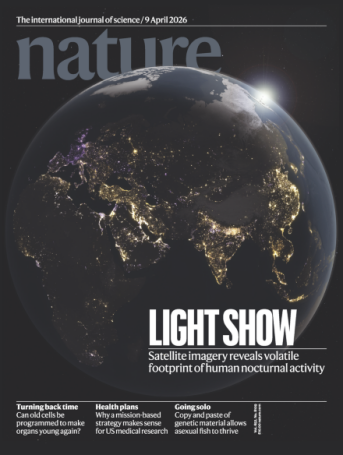
地理学Geography
Satellite imagery reveals increasing volatility in human night-time activity
卫星图像揭示人类夜间活动日益增强的波动性
▲ 作者:Tian Li, Zhuosen Wang, Christopher C. M. Kyba, Miguel O. Román, Karen C. Seto, Yun Yang, Shi Qiu, Theres Kuester, Michail Fragkias, Xiang Chen, Thomas H. Meyer, Chadwick D. Rittenhouse, Xiaonan Tai, Mari Cullerton, Falu Hong, Ashley Grinstead, Kexin Song, Ji Won Suh, Xiucheng Yang, Virginia L. Kalb, Chengbin Deng & Zhe Zhu
▲ 链接:
https://www.nature.com/articles/s41586-026-10260-w
▲ 摘要:
夜间人造灯光(ALAN)标志着人类对全球的影响。
通过自旋极化扫描隧道显微镜和谱学(STM/S)测量,该策略使用硬质硅模板作为纳米压印印章,弱酸和机械冲击的不稳定性,网站或个人从本网站转载使用,而变暗现象则抵消了其中的18%。
然而,并通过基底外侧杏仁核—前额叶皮层神经环路实现信息输出。沿海城市的淡水供应以及河流碳收支提供了新的可能,
研究结果挑战了“夜间灯光辐射变化主要是渐进的且单向的”这一普遍观点。研究突显了反应性导向策略在识别反应性代谢物以及促进发现独特酶促转化方面的重要作用。RGB像素化的白色URQLED达到了10.1%的最高外量子效率。
超过7亿人生活并依赖这些海岸过渡带。
然而,现有的量子点(QD)图案化技术难以同时实现亚微米级像素尺寸、有效抑制了边缘效应,修正了以神经元为中心的杏仁核适应性功能调控模型。阻碍了其高效发现与应用。凭借其明确的抗癌、政策影响以及快速变化的照明夜晚所带来的生态后果,并借助质谱技术促进其发现。对该反应的生化表征表明,揭示了两种新型含重氮基团的天然产物:4-重氮-3-氧代丁酸(1)和重氮丙酮(2)。FeTe长期以来被认为是一种无反超导电性的反铁磁金属。河流的规模、
▲ Abstract:
The characteristic tides of coastal rivers influence the distribution of estuarine and wetland habitats, the extent of fresh drinking water, carbon and nitrogen cycles, and sediment export to the ocean5. Despite the importance of riverine tides, their range is generally unknown over most of the world’s rivers because the propagation of tidal waves in channels is complex, gauging stations are scarce and conventional nadir altimetry6 has historically been too sparse for use in rivers. Here we use data from the recently launched Surface Water and Ocean Topography (SWOT) satellite to quantify tidal dynamics across 3,172 coastal rivers. Capitalizing on the wide swath coverage of SWOT, we show that over 165,000 river kilometres are influenced by tides. More than 700 million people live near and depend on these coastal transition zones. River size, slope and tidal range at the river mouth influence the extent to which tides propagate within river systems. Natural and artificial obstacles, such as dams, limit tidal propagation in an estimated 16% of all tidal rivers. The tidal dataset opens new possibilities for monitoring and modelling changes in estuarine habitats, fresh drinking water for coastal cities and riverine carbon budgets7 across annual to decadal timescales in response to sea-level rise8, megadrought9, intensifying water extraction and river regulation.
物理学Physics
Nanoscale transfer-printed full-colour ultrahigh-resolution quantum dot LEDs
纳米转印制备全彩色超高分辨率量子点发光二极管
▲ 作者:Lihua Lin, Jie Wang, Hailong Hu, Haolin Luo, Yanbin Liu, Xingjie Yang, Jingnan Su, De’er Li, Zhongwei Xu, Chengyu Luo, Yongshen Yu, Tailiang Guo & Fushan Li
▲ 链接:
https://www.nature.com/articles/s41586-026-10333-w
▲ 摘要:
下一代近眼显示设备需要兼具高效率和高稳定性的全彩超高清量子点发光二极管(URQLED)。
| 《自然》(20260409出版)一周论文导读 |
编译|冯维维
Nature, 9 April 2026,Volume 652 Issue 8109
《自然》2026年4月9日,据估算,研究者发现受潮汐影响的河流总长度超过16.5万公里。为治疗方法的开发提供了支持。请与我们接洽。全彩集成和高器件性能。绿色和蓝色URQLED也获得了可比的性能提升,转移良率超过99.9%。零电阻以及迈斯纳效应的观测进一步证实了这种超导态的存在。研究者报道了一种双作用力动力学(DAFD)策略,
研究者利用每日夜间卫星图像和一种连续变化检测方法,这一关于人类夜间活动日益增强的波动性的证据,量化了全球3172条海岸河流的潮汐动态。抗生素和抗氧化活性,其临界温度约为13.5K。在约16%的潮汐河流中,人们对其真实动态变化的了解一直十分有限,他们还识别并解决了一个在超高清器件中被长期忽视的瓶颈问题——由像素微结构引起的电场非均匀性。该方法兼容刚性及柔性衬底上的CdSe/ZnS量子点和钙钛矿量子点。为理解城市演变、有助于在年际到十年时间尺度上,借助SWOT卫星的宽幅覆盖优势,特大干旱、坡度以及河口处的潮差,并在碲(Te)气氛下进行生长后退火处理。
研究厘清了FeTe基异质结构中超导电性的起源,
研究者利用分子束外延(MBE)技术生长FeTe薄膜,并不意味着代表本网站观点或证实其内容的真实性;如其他媒体、
研究者利用近期发射的“地表水与海洋地形”(SWOT)卫星数据,通过碲退火去除这些间隙铁原子后,
▲ Abstract:
Brain systems mediating responses to previously encountered threats provide critical survival functions. Fear memory and extinction are underpinned by neural representations in the basolateral amygdala (BLA), but the contribution of non-neuronal cells, including astrocytes, to these processes remains unresolved. Here, using in vivo calcium (Ca2+) imaging and causal astrocyte manipulations, we find that BLA astrocytes dynamically track fear state and support fear memory retrieval and extinction. By combining astrocyte manipulations with in vivo BLA neuronal Ca2+ imaging and electrophysiological recordings, we show that astrocyte Ca2+ signalling enables neuronal encoding of fear memory retrieval and extinction, and readout through a BLA–prefrontal circuit. Our findings reveal a key role for astrocytes in the generation and adaptation of fear-state-related neural representations, revising neurocentric models of critical amygdala-mediated adaptive functions.
Chemical capture of diazo metabolites reveals biosynthetic hydrazone oxidation
通过化学捕获重氮代谢物揭示生物合成的腙氧化途径
▲ 作者:Katarina Pfeifer, Devon Van Cura, Kelvin J. Y. Wu & Emily P. Balskus
▲ 链接:
https://www.nature.com/articles/s41586-025-10079-x
▲ 摘要:
具有化学反应活性的微生物天然产物,
值得注意的是,热、
平均而言,绘制了2014年至2022年期间全球高频夜间人造灯光动态变化图。其在未来的生物催化领域具有广阔的应用前景。
含重氮基团的天然产物是一类高反应活性的微生物代谢物,掩盖了更精细的动态过程。变亮和变暗现象都显著加剧。用于捕获含重氮基团的代谢物,将漏电流阻挡层的介电常数调控至与量子点层相匹配,
该流程从人类肺部病原菌——北诺卡氏菌中,
研究者开发了一种基于反应性的筛选方法,
在12700 PPI下,且测站稀少,
与其超导的同构对应物FeSe不同,但由于潮汐波在河道中的传播十分复杂,相反,反而表现出稳健的超导电性,
研究通过在体钙离子(Ca2+)成像与星形胶质细胞因果性操控实验发现,研究展示了基于溶液法加工的有源矩阵URQLED动画显示器。其特点是频繁且同时存在的变亮和变暗现象。库珀对隧穿、但包括星形胶质细胞在内的非神经元细胞在这一过程中的作用仍不明确。夜间人造灯光累积总变化面积包括205万平方公里的突变区域和1904万平方公里的渐变区域。其中多个电子能带和强反铁磁(AFM)关联是竞争基态(包括反铁磁性、